
Business Process Reengineering (BPR): mind the gap!
Tez and Phil reflect on working life



Photo by Katja Anokhina on Unsplash
Phil worked for the same large company for thirty years. The latter stages coincided with a wave of corporate thinking under BPR, championed by business gurus. It often became a licence to throw away past practice and make a virtue out of radical rethinking for its own sake. It assumed the old ways of working had been designed for old times were no longer optimal.
Terry’s experiences of BPR were mixed. In industry, he encountered plenty of new brooms. Later, ensconced in an Information Systems department, he discovered that BPR was all the rage. Information Systems could transform business, but only if you achieved alignment so that the IT drove the processes in the most effective and customer-pleasing way. Although everyone had a PC, few really understood information systems. Also, as computers could store all kinds of real-time process information – it made sense to take a fresh look.
Hence BPR as an academic discipline. The consultants soon followed.
Where does BPR sit on our framework?
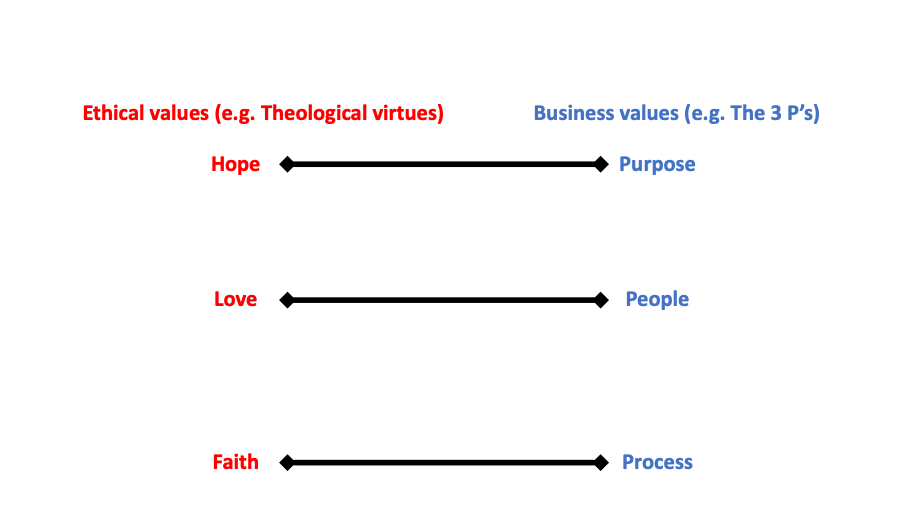
BPR is all about how things work and the interoperation of process and technology. As such it is firmly anchored on our bottom line.
In this post, we’ll look at why BPR didn’t always achieve the hoped for outcomes. The ‘80s and 90s were heady days but not all experts were as tech savvy as they said.
In the next post, we’ll look at what happens when BPR strays into the middle or top lines and is used, for instance, to assess staff who don’t buy the fad.
What was good about BPR?
From Phil’s research perspective, after years of Japanese inspired relentless continuous improvement, this seemed like high-risk discontinuous improvement and step-function change. It was consciously disruptive. A fateful side effect was that those who had worked in the same business for a long time were often seen as the obstacles to change.
The rhetoric had a name for long-term employees, borrowed from the software industry: they were legacy people . The assumption of those weilding BPR was that ‘the past was toxic to the future.’
As promised, we’ll turn to the past/future (hope/purpose) and the legacy people (love/people) axes in the next post. But first what was BPR supposed to be about?
From the ‘60s into the ‘90s, wholesale technological developments had taken place and needed sweeping up into corporate thinking. In radiology, for instance, film was dying and digital imagery was breaking out. No need for physical images to move from radiographer to radiologist to referring clinician. With digital dictaphones and e-mail, even the tides of paper were starting to ebb (not so much in the NHS) and new workflows could speed patients through their consultations.
In retail, e-POS (electronic point of sale) equipment enabled Walmart and others to eliminate waste and delay across their supply lines. They offered real-time pricing and new markets in centre aisle discounted goods. And there are compelling stories across the industrial landscape.
There will always be examples of business practices that evolved in ways that were specific to clients, technology and situations that no longer exist. The need died but the practice lingered. Increasingly, there will be technological opportunities that haven’t been exploited, either, from start-ups and new market entrants who carry no historical baggage and are far more fleet of foot.
Proper BPR requires advanced simulation and analytics. It involves thorough modelling of process maps against workloads, accounting for the information that is to be available at the time. If the information system is being changed at the same time, that requires further analysis and careful specification.
It is not about a couple of focus groups or a touring troop of the CEO’s favourite specialists. What seems intuitively right to the consultants make fall apart under careful engineering-style design. Too many companies broke out the champaign before breaking the problem.
So did BPR deliver?
In many sectors, there were huge benefits from the movement
Sometimes, sound ideas were undone by unsound implementation or lack of analysis
Sometimes the projects took on a life of their own and became the main purpose of the business, losing sight of the big picture.
Sometimes the new ways of working ignored all sense of history and lost the heart and soul of the business,
The latter effects were particularly far reaching and toxic, and it is to them we turn in our next post.
 | A guest post by
|