
Feynman’s lost lecture by David and Judith Goodstein
An occasional book review

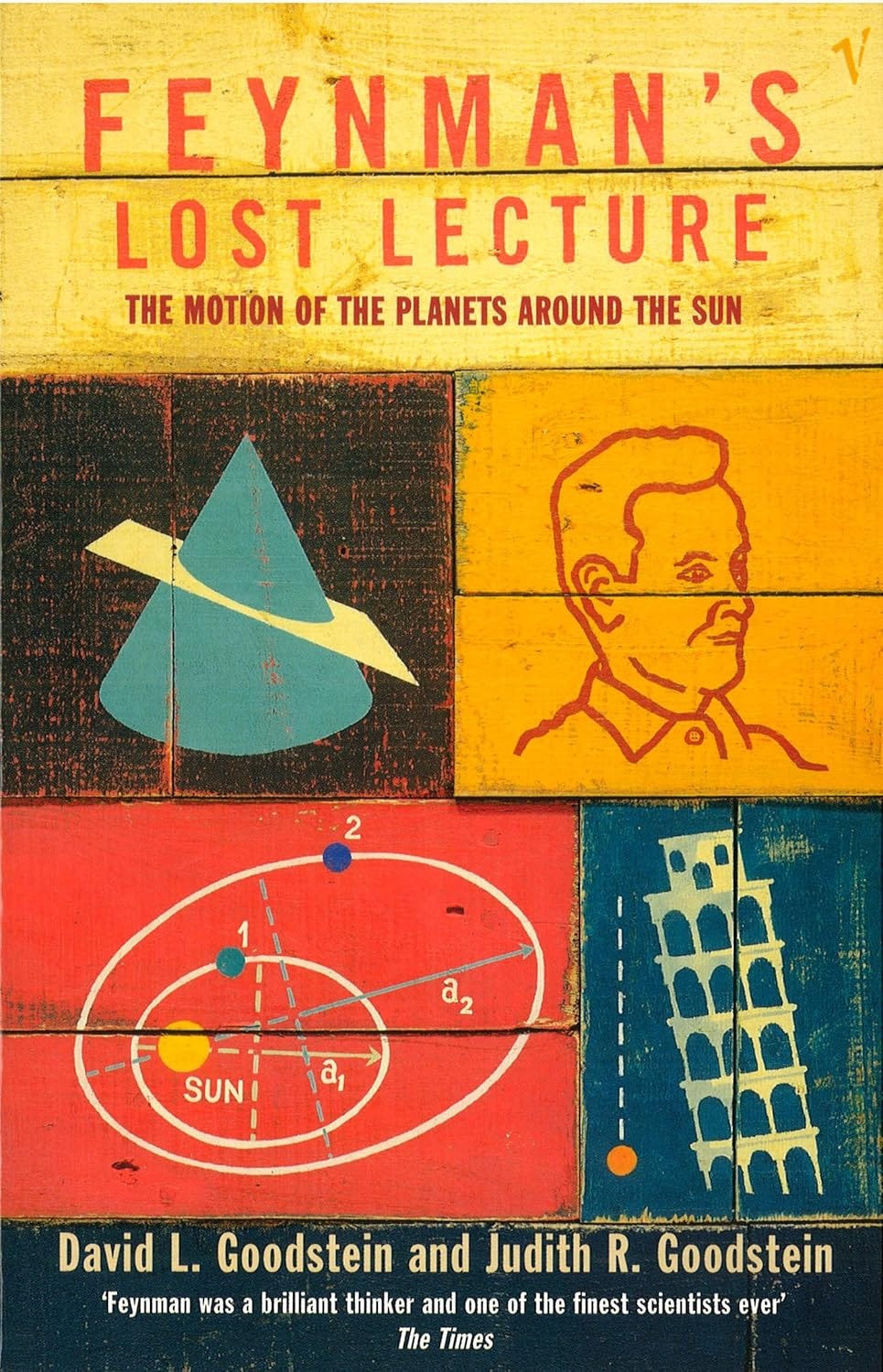
Image source for the 1996 edition (on Kindle, here).
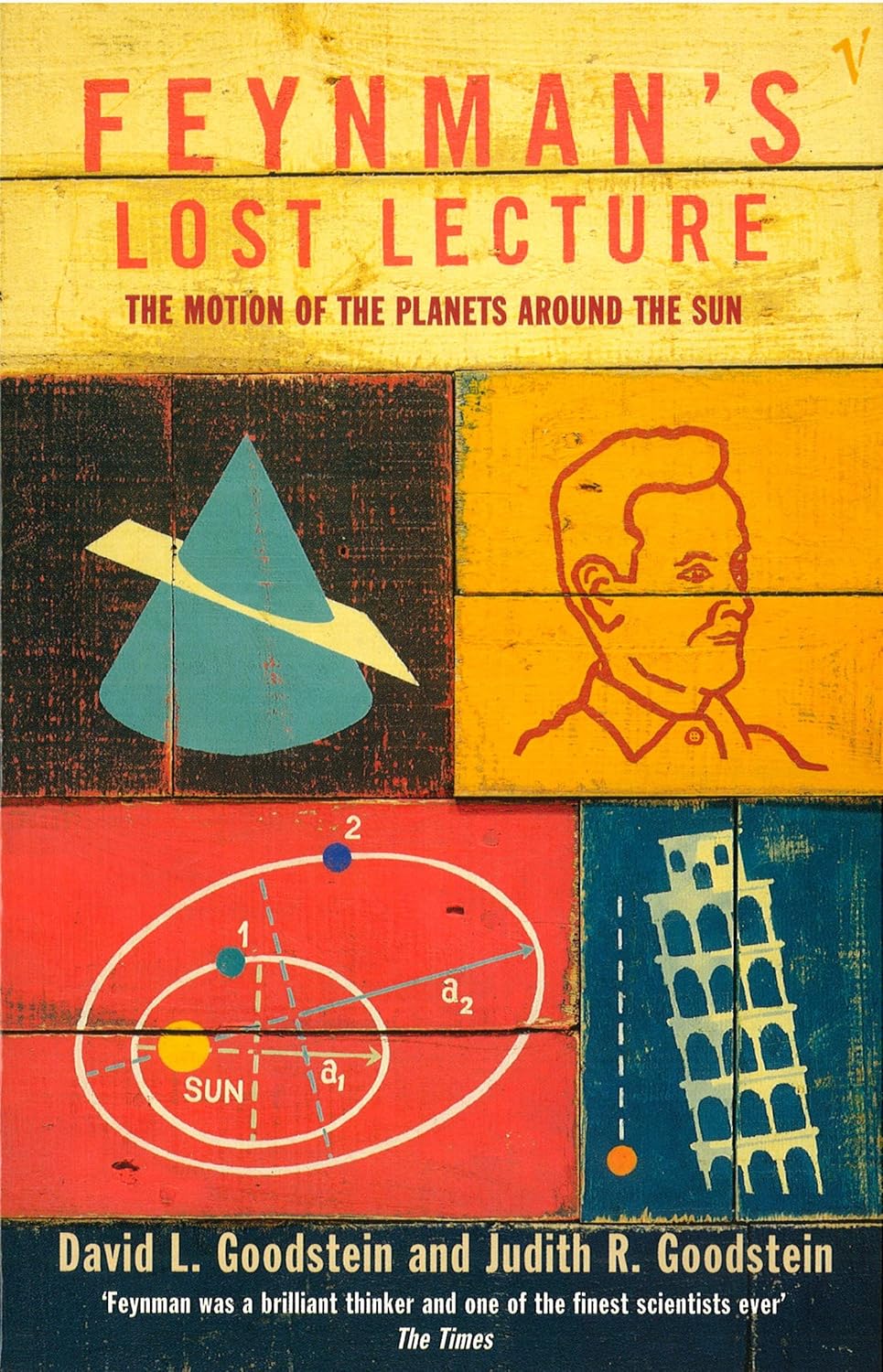
This book was a gift from a colleague at Brunel, Lampros Stergioulas (see here), with whom I was collaborating in research on healthcare modelling. He now holds the UNESCO Chair in AI and Data Science for Society at The Hague University of Applied Sciences, about which I’m really pleased.
Feynman is one of my heroes: I’d bought two volumes of his famous lectures as a student and received The New Millenium boxed set for Christmas, recently. This is the story of a guest lecture given at Caltech a year before he picked up his Nobel Prize.
It’s by a husband-and-wife team. David was a physicist who worked closely with Feynman and who died last year; while his wife, Judith also did a PhD in science before becoming an archivist, and survives him.
I remember sitting down with it as soon as I received it and when I was considering what to review, I sat down and read it again and discovered how much I’d forgotten and how it was even more worth promoting.
As usual, this isn’t a very good review. If you’re short of time, here’s the summary of what I liked:
The puzzle. That physical phenomena can be understood through abstract mathematical constructs is a mystery. The irony here is that while the Greeks had the geometry to describe what was going on in the heavens, their presuppositions about what ought to be happening meant that the elegant ellipses, slipped through their fingers. Feynman shows how better observation backed by Newton’s laws closed the loop with a satisfying picture of what is happening out there.
The pedagogy. For this group of students, Feynman oddly follows Newton’s geometric method. It took a huge amount of prep, driven by sheer curiosity and opens the soul of one of the greatest teachers of science. As far as I know, most of the method was out there already, but he worked through it for himself.
The parentheses. Although the heart of the book works through the methods in detail for the general reader and presents the lecture itself, this is bracketed by two pieces of history. First, a history of scientific thought from Aristotle to Newton; then an epilogue from Rutherford into the new physics of relativity and quantum mechanics. Second, there is a condensed biography of Feynman, with personal material that David provides and that I hadn’t found elsewhere.
The puzzle
The puzzle comes in several pieces. Outer space is full of ellipses, part of a family of curves called conic sections.
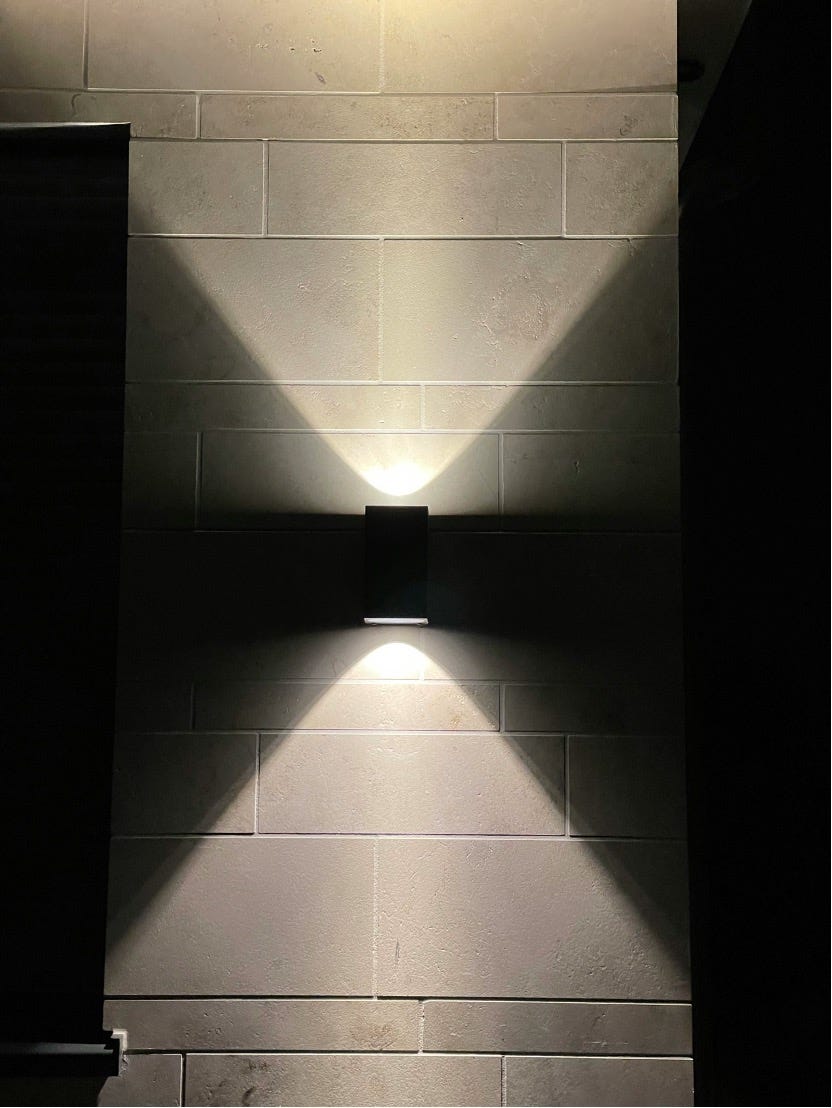
Photo by Bernd 📷 Dittrich on Unsplash
In the picture, two back-to-back cones of light illuminate a wall and trace out two hyperbolas. If we tilt the light until you can see a complete spot, one of the cones becomes an ellipse, and if you tilt further and bring the light far enough from the wall you can make a circle. The Greeks weren’t great with illumination but had discovered conic sections – probably during Aristotle’s lifetime – and were red hot with geometry.
As it happens, the hyperbola describes the path of an object from outer space that hurtles into our solar system, slingshots past the sun and disappears in a different direction. Our orbit is nearly circular while Halley’s Comet is massively skewed (or elliptical).
The Greeks were great thinkers; not big on experiments; their preconceptions rather poor. The upshot is that humanity got saddled with idealist maths – circles and spheres – that didn’t quite work in the heavens.
By Newton’s time there is some astronomical data leading to Kepler’s ‘laws,’ while Newton’s force that pulled apples from trees (or whatever it was that he probably didn’t see in the garden that day) was another puzzle piece.
Feynman’s Lost Lecture pulls all this together – ellipses, gravity, inverse square laws – to explain why Kepler got the data he did and why it all fitted to neatly into an ellipse.
Because he is in playful mood, Feynman decides to prove how gravity, that gets weaker as you pull away from its source (precisely as one over the square of the distance) accounts for all this: but he does it entirely with geometry!
I struggled with conic sections at A-level and in the end decided to survey past papers and see if I could get a decent grade without the conic section question rather than sorting the theory. Clearly Feynman knows his conic sections but, curiously, Newton knew things that Feynman couldn’t follow so at times he must clear his own path.
Anyhow, David works us through the theory in Chapter 3, filling in the gaps that Feynman swerves past in the lecture. This is exceptionally helpful, although there were a couple of instances where I followed Feynman’s line more easily. There’s neat geometry on show and, as promised, you can follow it all with just a firm grasp of geometry.
Exquisitely satisfying – the force, the shapes, the diagrams – and at the end, Feynman takes us back just 50 years to Rutherford’s experiments with a-particles and gold leaf for a final flourish. Newton’s 250+ year-old ‘solar system’ picture that he has just proven, showed that atoms, too, had a very small, very heavy core, and that the centre was also the origin of a force with an inverse square law.
The pedagogy
Feynman’s line flows over Chapter 3, as David prepares us, and into Chapter 4 where Feynman delivers in his inimitable style. The lecture itself was recorded, so we have pretty much the verbatim delivery, but only one photograph survives.
Two things struck me about how Feynman goes about this problem. I noted how passionate he is about the elegance of the curves against the rigour and speed of equations. It left me wishing in many ways that I’d learned my conic sections with the Greeks. By the time I learned conic sections, the examiners couldn’t wait to ditch the diagrams and convert everything into parametric equations (which always turned to runic under my pen). It’s a surprising longing from someone who’s legacy is of so much theory in symbols. Maybe it explains why he left us with Feynman diagrams, too!
The other thing is that he follows Newton in dividing the planetary motion into triangles, the start and finish over a short period of time, and back to the source (or focus), namely the sun. Although he doesn’t use calculus, he uses the argument that the triangles get thinner until the resultant polygons become smooth circles or ellipses. Making the leap in that way results in some very elegant constructions to show what happens in real space and in velocity space.
Even when he is teaching the trajectory of a projectile to freshmen in The Feynman Lectures, he uses the same steps and does it all numerically, first. In both cases, he chooses methods that let you ‘see’ what is going on, rather than simply turning the algebraic handle.
The parentheses
Around this core, David and Judith have arranged historical material. Nestled next to the start of the geometric prep is a short biography of Feynman. Since David worked with him, even running the freshman course that Feynman had kicked off, you get a close-up view.
There’s a story, for instance, about Feynman’s quirky sense of humour when he was miffed at David. Feynman saw the funny side of a lot of things, but he took his physics very seriously and didn’t appreciate the gentle pun in a title David had generated in Feynman’s absence, that Feynman had to live with on his return. His revenge was to embarrass David (while mispronouncing his surname) by sharing a private comment made at a public lecture. Only, Feynman turned the ad hoc remark into a well-articulated insight, while claiming not to understand it because it was all David’s idea.
Bracketing the biography, the geometry primer and the lecture itself, is more history. At the start, a review covers Aristotle to Copernicus, Tycho Brahe and Kepler, up to Newton.
Physics is a delicate dance between the logic of theory and the affirmation of experiment. Where evidence is good, theory must bow to empirical data. Kepler’s ‘laws’ weren’t laws in any strict sense: they reflected curve fitting to astronomical observations. By reading the implications and putting forward his own theory that showed how Kepler’s curves were the inevitable result of gravitational attraction, Newton brought science to bear and overthrew centuries of Greek presuppositions. All this is packaged as a neat history lesson in science and discovery, presumably by Judith.
The epilogue finishes this narrative as it picks up Rutherford’s scattering experiment, which is where Feynman ends his talk, and notes that Rutherford’s result was also a seminal moment as Newton’s ideas began to unravel. The problem is that atoms are not solar systems in miniature, or else the universe would quickly have radiated away. And so, it set the scene for the new physics, immediately with quantum mechanics and inevitable with relativity.
However, Newton was not wrong in the way that Aristotle was wrong. Aristotle was wrong because he was completely wrong. Newton was wrong because he was almost right – almost but not quite.
And so, we circle around the central mystery – why should the unbearable complexity of reality reduce itself so readily to elegant pictures? As an atheist (as Feynman was), you catch a beat of the heart of nature. As a Christian you may sense the mind of God.
Let’s close with some poetry from one of my favourite writers: he inscribed this in something he gave to a young friend:
This is the sort of book we like
(For you and I are very small),
With pictures stuck in anyhow,
And hardly any words at all.
. . .
You will not understand a word
Of all the words, including mine;
Never you trouble; you can see,
And all directness is divine—
Stand up and keep your childishness:
Read all the pedants’ screeds and strictures;
But don’t believe in anything
That can’t be told in coloured pictures.
GK Chesterton (1874-1936)
Other books I’ve reviewed: a mix of what friends have written or things that caught my eye
When nothing beats anymore by Ineke Marsman-Polhuijs (16 December 2024)
A handful of pennies by Afaf Musalam (18 February 2025)
Wonder drug by Jennifer Vanderbes (5 May 2025)
Coming to faith through Dawkins eds. Denis Alexander and Alister McGrath (4 August 2025)
Testosterone by Carole K Hooven (22 September 2025)
Taboo by Nigel Halliday (6 October 2025)